
Plate Load Test Mumbai | Verify Soil Bearing Capacity & Foundation Safety | KNACK
Every successful structure begins with a foundation capable of safely transferring loads to the underlying ground. Whether the project involves residential towers, industrial facilities, commercial developments, substations, equipment foundations, or infrastructure assets, understanding how soil behaves under actual loading conditions is critical to long-term performance.
While geotechnical investigations and laboratory testing provide valuable information about subsurface conditions, soil behaviour can vary significantly across a site. Localised changes in density, moisture content, stratification, and material composition may influence foundation performance in ways that are difficult to predict through calculations alone.
This is why the plate load test in Mumbai has become one of the most trusted methods for verifying foundation design assumptions. By applying controlled loads directly to the ground at the proposed foundation level, engineers can obtain site-specific data on bearing capacity and settlement behaviour before construction begins.
Why Field Verification Matters for Foundation Design
The safety and stability of shallow foundations depend on the interaction between structural loads and supporting soil layers. Even when borehole investigations indicate favourable conditions, actual field performance can differ because of natural ground variability.
Foundation failures are often associated with excessive settlement, differential movement, or inadequate load-bearing capacity. These issues can lead to structural distress, serviceability problems, costly repairs, and project delays.
Conducting in-situ geotechnical testing allows engineers to observe how the ground responds under realistic loading conditions. The resulting data provides a higher level of confidence when determining foundation dimensions, allowable bearing pressures, and settlement tolerances.
Understanding the IS 1888 Protocol
The IS 1888 protocol establishes the standard methodology for conducting plate load tests in India. The objective is to evaluate the load-settlement relationship of soil at the proposed foundation depth and determine its ability to support structural loads.
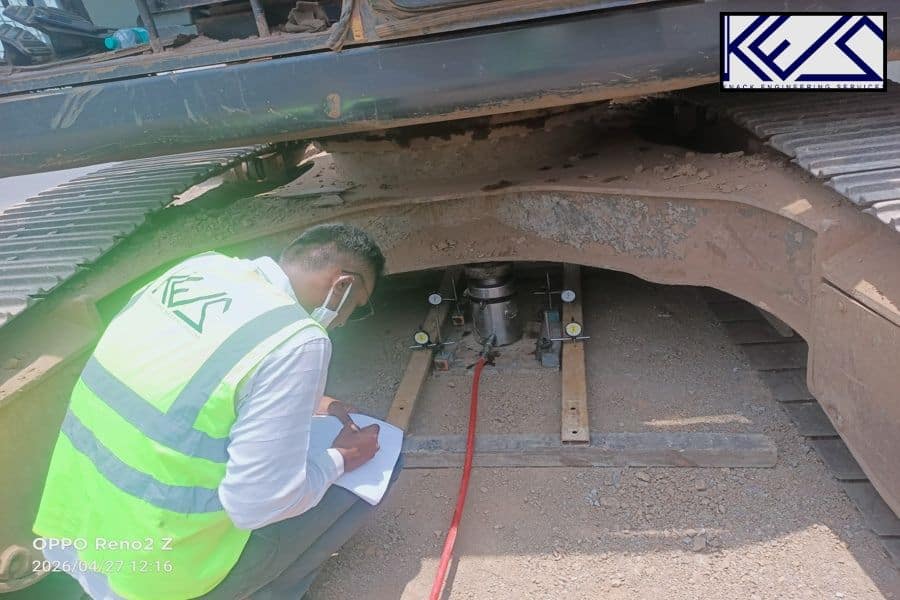
The test is performed by placing a rigid steel plate of known dimensions on a prepared soil surface at foundation level. A hydraulic loading system is then used to apply vertical loads in a controlled and incremental manner.
Settlement measurements are recorded throughout the test using highly sensitive dial gauges mounted on an independent reference system. As loading progresses, engineers carefully monitor the response of the soil and document its deformation characteristics.
The process continues until either the soil reaches failure conditions or the specified maximum test load is achieved.
Soil Bearing Capacity Calculation Through Field Testing
One of the primary objectives of the plate load test is supporting accurate soil bearing capacity calculations.
Bearing capacity represents the maximum pressure that soil can safely withstand without experiencing excessive settlement or shear failure. Determining this parameter accurately is essential for designing economical and reliable foundations.
Field testing provides direct measurements of load and settlement behaviour, enabling engineers to evaluate both ultimate and allowable bearing capacities. Unlike theoretical calculations alone, site-specific testing captures the actual behaviour of the ground under loading conditions.
This information is particularly valuable for projects involving:
- Industrial structures
- Commercial buildings
- Utility installations
- Equipment foundations
- Warehouses
- Infrastructure developments
- Heavy load-bearing structures
Evaluating Foundation Settlement Characteristics
Often, settlement performance is just as important as bearing capacity.
A soil layer may possess sufficient strength to support structural loads while still experiencing unacceptable settlement. Excessive settlement can affect structural alignment, floor performance, utility connections, and operational efficiency.
By analysing foundation settlement characteristics, engineers gain insight into how the soil compresses as load levels increase. Load-settlement curves generated during testing help identify deformation trends and provide valuable input for foundation design.
These findings assist structural designers in selecting foundation systems that minimise future movement and ensure long-term serviceability.
In-Situ Geotechnical Testing for Real-World Performance
Unlike laboratory testing, which evaluates relatively small soil samples, in-situ geotechnical testing examines soil behaviour in its natural environment.
This approach accounts for field conditions such as the following:
- Natural soil structure
- Moisture variations
- Layer interactions
- Density differences
- Site-specific ground behaviour
Because the soil remains undisturbed during testing, the results often provide a more realistic representation of actual foundation performance.
For project management consultants, developers, and structural engineers, this level of verification significantly reduces uncertainty during the design stage.
Open Footing Validation Before Construction Begins
The open footing validation process is an important quality assurance step for projects relying on shallow foundation systems.
By verifying foundation performance before construction progresses, project teams can identify potential concerns early and implement corrective measures when necessary. This proactive approach reduces the risk of unexpected settlement, redesign requirements, and construction delays.
Open footing validation also supports compliance with project specifications and provides documented evidence that foundation recommendations are based on measured field performance rather than assumptions alone.
Frequently Asked Questions
What is a plate load test?
A plate load test is a field test used to determine soil bearing capacity and settlement behaviour by applying controlled loads to a steel plate placed at foundation level.
Which standard governs plate load testing in India?
The test is conducted according to the IS 1888 protocol, which outlines the procedures for determining bearing capacity and settlement characteristics.
What are foundation settlement characteristics?
Foundation settlement characteristics describe how soil compresses and deforms under structural loads over time.
Final Buildup – Independent Third-Party Testing for Greater Confidence
As projects become larger and more technically demanding, independent verification has become increasingly important.
KNACK ENGINEERING SERVICES PRIVATE LIMITED provides professional plate load test Mumbai services as an independent third-party testing partner. Our experienced field engineers conduct testing in accordance with the IS 1888 protocol, delivering objective results that support informed engineering decisions.
We conduct testing activities as follows:
NABL Certificate Number TC-6828 – Mumbai Head Office and Field Divisions
NABL Certificate Number TC-15250 – Taloja Branch Facility
KNACK ENGINEERING SERVICES PRIVATE LIMITED helps project stakeholders build safer foundations and reduce long-term structural risks by conducting thorough field investigations, accurately calculating soil bearing capacity, carefully evaluating foundation settlement characteristics, and reliably validating open footings.
By validating soil performance before construction begins, project teams can move forward with confidence, knowing that real-world field data supports critical foundation decisions.
Image Reference: Magnific
Disclaimer: All trademarks, logos, and brand names are the property of their respective owners. All company, product, and service names used in this website are for identification purposes only. Use of these names, trademarks, and brands does not imply endorsement.