
Vertical Compressive Pile Test | Validate Deep Foundation Performance | KNACK
The increasing height and complexity of the modern structures have greatly increased the demands on the foundation systems. High-rise residential towers, commercial developments, industrial facilities, bridges and infrastructure projects frequently impose loads that exceed the capacity of near-surface soils. In these cases, deep foundations are necessary to transfer structural loads to stronger strata at greater depths.

Although pile foundations are often used to support such demanding structures, their performance cannot be assumed based solely on design calculations or construction records. The actual load-carrying behaviour of a pile under field conditions must be verified to ensure it can safely support the intended structural loads.
The vertical compressive pile test is therefore essential. This field-based evaluation is carried out as per IS 2911 Part 4 and provides direct evidence of the performance of piles, which helps confirm the adequacy of deep foundation systems before project completion.
Why Deep Foundation Validation Is Essential
Deep foundations are designed to transfer structural loads through weak or compressible upper soil layers and into stronger bearing strata located below.
The success of this load transfer mechanism depends on several factors, including:
- Pile installation quality
- Concrete integrity
- Subsurface conditions
- End-bearing performance
- Friction pile skin resistance
- Interaction between the pile and surrounding soil
Even when construction follows approved procedures, variations in geology and installation conditions can influence actual performance. As a result, deep foundation validation is an essential quality assurance activity for critical projects.
By performing field load testing, project stakeholders gain confidence that piles can safely carry the loads anticipated by the structural design.
Understanding the Vertical Compressive Pile Test
The vertical compressive pile test is widely recognised as the most reliable method for assessing the axial load-carrying capacity of piles.
The test involves applying controlled vertical compressive loads to a pile while accurately measuring settlement at each loading stage. By monitoring the relationship between applied load and pile movement, engineers can evaluate how the foundation behaves under actual field conditions.
Unlike theoretical calculations alone, this approach provides direct performance data that reflects the combined influence of soil conditions, pile construction quality, and load-transfer mechanisms.
For high-value developments, the vertical compressive pile test offers critical validation before structural loading begins.
The Importance of IS 2911 Part 4
The testing procedure is governed by IS 2911 Part 4, which establishes standard requirements for conducting pile load tests in India.
The standard outlines procedures for:
- Initial pile load testing
- Routine pile load testing
- Load application methods
- Settlement measurements
- Acceptance criteria
- Reporting requirements
Compliance with IS 2911 Part 4 ensures consistency, reliability, and technical accuracy throughout the testing process. It also provides project consultants and regulatory authorities with confidence that the results have been obtained using recognised industry practices.
Hydraulic Jack Load Testing and Reaction Systems
A key component of the testing process is the application of controlled loading with specialised equipment.
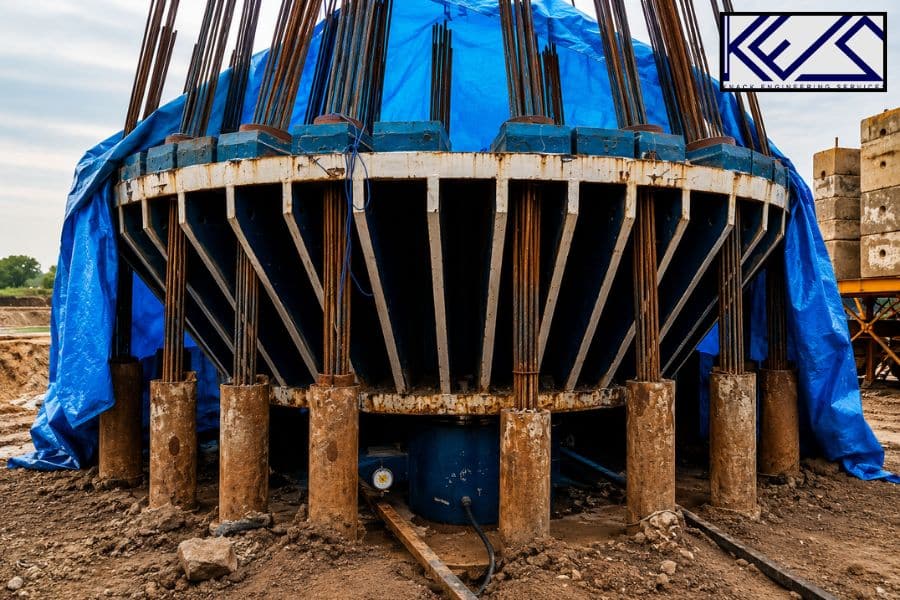
During hydraulic jack load testing, a high-capacity hydraulic jack applies vertical force directly to the pile head. To generate the required reaction force, the system typically relies on one of two arrangements:
- Kentledge systems consisting of heavy steel frames and counterweights
- Ground anchor systems designed to resist uplift forces
The applied loads are increased incrementally, and settlement readings are recorded using precision instrumentation. This controlled loading process enables engineers to observe pile behaviour throughout the test and identify any signs of excessive movement or performance limitations.
The accuracy of hydraulic jack load testing is one of the reasons why it remains the preferred field validation method for deep foundations.
Evaluating Friction Pile Skin Resistance
Many piles derive a significant portion of their load-carrying capacity from friction pile skin resistance.
This resistance develops through interaction between the pile surface and the surrounding soil layers. As structural loads are applied, shear forces mobilise along the pile shaft, which contributes to the overall foundation capacity.
The vertical compressive pile test helps verify that the expected skin friction has developed adequately under field conditions. This information is particularly important for piles installed in clay, silt, and granular deposits where shaft resistance contributes substantially to foundation performance.
By evaluating the skin resistance of friction piles, engineers can better understand load-transfer mechanisms and confirm compliance with design assumptions.
Initial and Routine Pile Testing
Pile load testing may be performed on either initial test piles or routine working piles, depending on project requirements.
Initial tests are generally conducted to establish the ultimate load-carrying capacity of a pile design before large-scale construction begins. These tests often involve loading well beyond the working load to evaluate performance limits.
Routine tests, on the other hand, are typically carried out on production piles to verify construction quality and confirm consistency across the foundation system.
Both forms of testing contribute to effective deep foundation validation and support informed engineering decisions throughout the construction lifecycle.
Frequently Asked Questions
What is a vertical compressive pile test?
A vertical compressive pile test evaluates the axial load-carrying capacity and settlement behaviour of a pile under controlled loading conditions.
Which standard governs pile load testing in India?
Pile load testing is conducted according to IS 2911 Part 4, which specifies procedures and requirements for pile load tests.
What is hydraulic jack load testing?
Hydraulic jack load testing uses high-capacity hydraulic jacks to apply controlled compressive loads to a pile during testing.
Final Buildup – Independent Third-Party Verification for High-Rise Projects
As projects become more technically demanding, independent verification has become increasingly important for developers, project management consultants, structural designers, and contractors.
KNACK ENGINEERING SERVICES PRIVATE LIMITED provides specialised pile testing services as an independent third-party testing partner. Our experienced field engineering teams conduct testing in accordance with the pile load test standard established under IS 2911 Part 4, delivering accurate and objective performance evaluations.
Our field testing operations are officially accredited under:
NABL Certificate Number TC-6828 – Mumbai Head Office and Field Divisions
NABL Certificate Number TC-15250 – Taloja Branch Facility
Through advanced hydraulic jack load testing, detailed assessment of friction pile skin resistance, and comprehensive deep foundation validation, KNACK ENGINEERING SERVICES PRIVATE LIMITED helps ensure that critical foundation systems perform safely and reliably throughout the life of the structure.
For projects where foundation performance cannot be left to assumptions, independent field verification provides the confidence required to build higher, stronger, and safer.
Image Reference: Freepik
Disclaimer: All trademarks, logos, and brand names are the property of their respective owners. All company, product, and service names used in this website are for identification purposes only. Use of these names, trademarks, and brands does not imply endorsement.