
Plate Load Test Mumbai | Foundation Validation & Settlement Analysis | KNACK
The performance of any structure starts with the performance of its foundation system. Engineers need to ensure that the soil underneath can handle what is expected from the structural loads, be it a commercial property, industrial site, residential high-rise, warehouse or infrastructure asset. Even the best conceived superstructure is vulnerable to problems in the long run if foundation parameters are based on assumptions rather than verified field data.

Before finalising footing dimensions, raft foundations, or isolated column bases, structural engineers require accurate information regarding soil strength and expected settlement behaviour. While borehole investigations and laboratory analysis provide valuable insights, actual field conditions can vary significantly across a site. This is why a plate load test Mumbai service is considered one of the most reliable methods for validating foundation design assumptions.
Why In-Situ Foundation Verification Matters
Underground soil conditions are rarely uniform. Changes in density, moisture content, layering and geological composition can directly affect the performance of foundations. If prediction is based on only theoretical calculations, it could result in unexpected settlement, differential movement or reduction in load bearing capacity.
Field-based verification allows engineers to evaluate soil behaviour under actual loading conditions. Through in-situ geotechnical testing, project teams gain confidence that foundation designs are based on real-world performance rather than estimated values.
This approach helps developers, consultants, and contractors minimise risk while improving overall structural reliability.
Understanding the IS 1888 Plate Load Test
The IS 1888 protocol establishes the standard procedure for conducting plate load testing in India. The test simulates how soil will respond when subjected to structural loads by applying controlled pressure at the proposed foundation level.
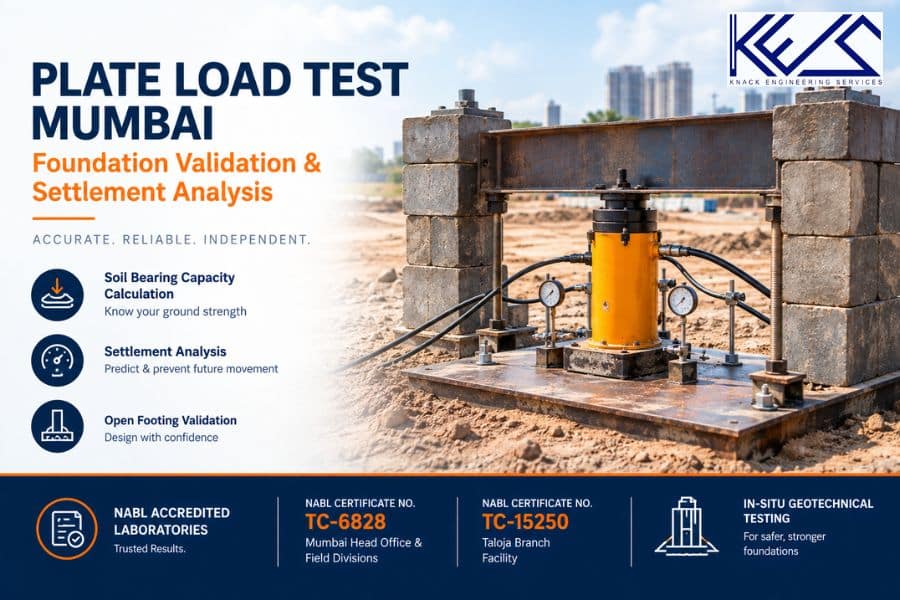
The procedure involves placing a rigid steel plate of known dimensions directly on the prepared test surface. Incremental vertical loads are applied by a hydraulic jack against a reaction system which may be kentledge blocks, a reaction beam or ground anchors.
Throughout the entire loading process, values of settlement are continuously recorded by high precision dial gauges, mounted on an independent reference frame. The loading is continued until the predetermined limits are reached or the soil shows signs of failure.
Because the test evaluates actual field performance, it remains one of the most trusted methods for open footing validation and foundation design verification.
Soil Bearing Capacity Calculation and Settlement Analysis
One of the primary objectives of the test is to support accurate soil bearing capacity calculation. By analysing the relationship between applied load and measured settlement, engineers can determine the safe bearing capacity of the soil and identify its ultimate load-carrying potential.
Equally important is the evaluation of foundation settlement characteristics. Excessive settlement can cause structural distress, cracking, uneven floor levels, and serviceability issues. Understanding settlement behaviour before construction begins allows engineers to optimise foundation dimensions and reduce long-term risks.
The test therefore provides two critical design parameters:
- Safe Bearing Capacity (SBC)
- Foundation Settlement Characteristics
Together, these values form the foundation of reliable shallow foundation design.
Applications of Plate Load Testing
Plate load testing is widely used across various construction sectors, including:
- Commercial developments
- Industrial facilities
- Residential high-rise projects
- Warehousing and logistics parks
- Infrastructure and transportation projects
- Heavy equipment foundations
- Large raft foundation systems
Wherever shallow foundations are planned, the test provides valuable information for engineering decision-making and quality assurance.
Independent Third-Party Foundation Verification
For critical projects, independent testing provides an additional layer of confidence. As an experienced third-party testing partner, KNACK ENGINEERING SERVICES PRIVATE LIMITED delivers professional in-situ geotechnical testing services that support developers, project management consultants, contractors, and structural designers.
Our field engineering teams test strictly as per IS 1888 protocol and generate accurate and objective reports that ensure safe and efficient construction.
These specialist testing services are backed up by:
- NABL Certificate Number TC-6828 – Mumbai Head Office and Field Divisions
- NABL Certificate Number TC-15250 – Taloja Branch Facility
Frequently Asked Questions
What is a plate load test?
A plate load test is a field investigation method used to determine soil bearing capacity and settlement characteristics by applying controlled loads to a steel plate placed at foundation level.
Why is the IS 1888 protocol important?
The IS 1888 protocol provides standardised procedures for conducting plate load tests, ensuring accuracy, consistency, and reliable engineering results.
Final Buildup
Foundation failures are often caused by incorrect assumptions about soil behaviour. Mumbai plate load test provides direct field evidence of soil performance and guides engineers in making informed decisions regarding bearing capacity and settlement.
Through accurate soil bearing capacity calculation, detailed assessment of foundation settlement characteristics, and professional open footing validation, KNACK ENGINEERING SERVICES PRIVATE LIMITED helps ensure that shallow foundation systems are designed with confidence, precision, and long-term structural safety in mind.
Image Reference: Magnific
Disclaimer: All trademarks, logos, and brand names are the property of their respective owners. All company, product, and service names used on this website are for identification purposes only. Use of these names, trademarks, and brands does not imply endorsement.