
Vertical Pile Load Testing | Deep Foundation Validation | KNACK
As modern buildings, bridges, industrial facilities, and infrastructure projects continue to grow in size and complexity, foundation systems must be capable of safely transferring enormous structural loads into the ground. When near-surface soils lack adequate bearing capacity, engineers rely on deep pile foundations to support the structure and ensure long-term stability.

However, designing and installing piles is only part of the process. The actual performance of a pile under field conditions must be verified before construction progresses. This is where the vertical compressive pile test plays a critical role. Conducted according to IS 2911 Part 4, this test provides direct evidence of a pile’s load-carrying capacity and confirms that the foundation system can safely support the intended structure.
Why Deep Foundation Validation Matters
Deep Foundations are designed to carry the structural loads through weaker soil layers to stronger strata at greater depths. The performance of is dependent on many factors including ground conditions, quality of pile installation, integrity of concrete, and the interaction between the pile and surrounding ground.
Even with the most careful design and construction, variations in subsurface conditions can impact the actual performance of foundations. If not properly tested, these variations may not be discovered until excessive settlement or structural problems occur.
Deep foundation validation helps eliminate uncertainty by confirming that installed piles perform as intended under actual loading conditions.
Understanding the Vertical Compressive Pile Test
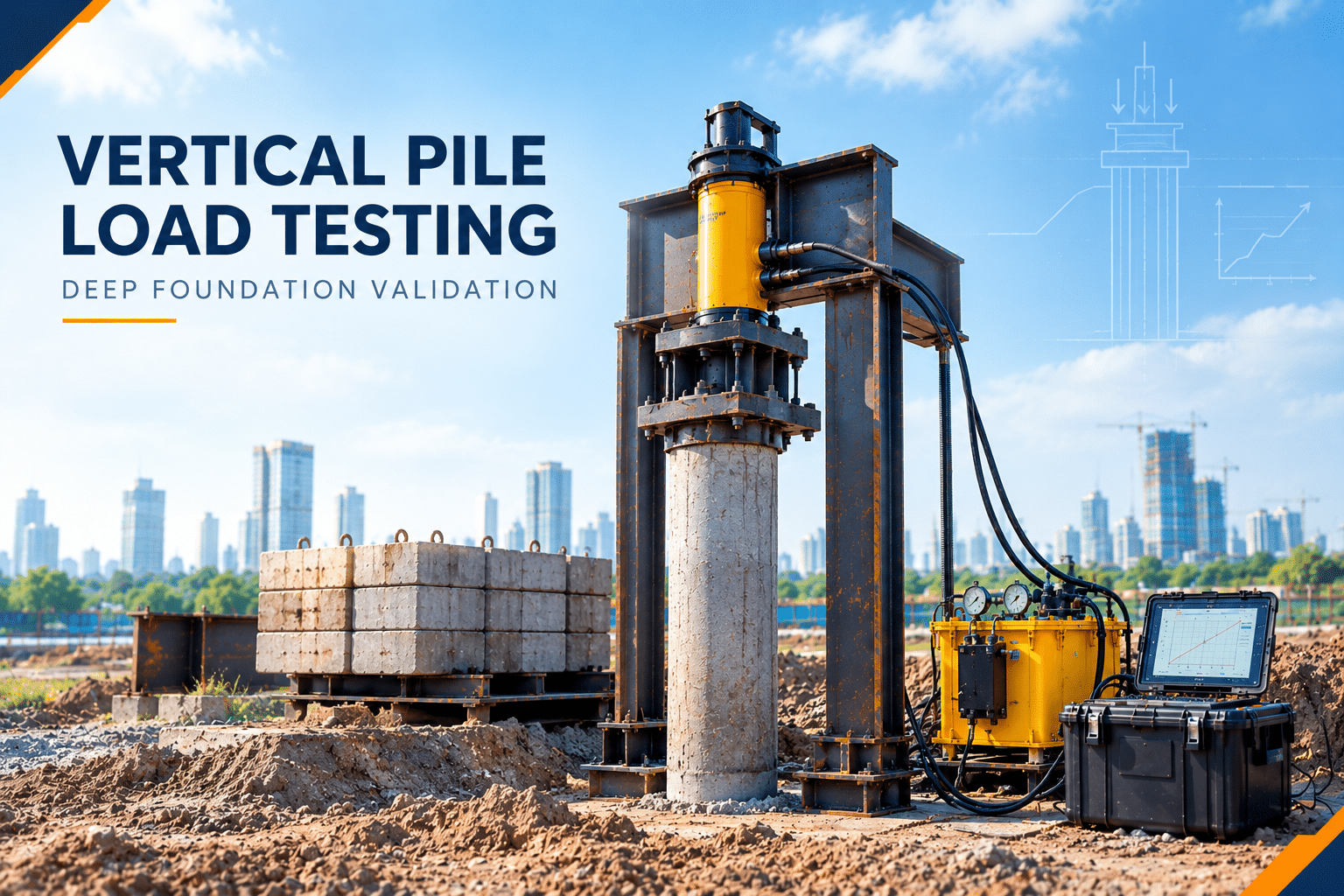
The vertical compressive pile test is widely regarded as the most reliable field method for evaluating pile performance. During the test, controlled vertical loads are applied to a pile while settlement readings are measured at each loading stage.
The relationship between applied load and pile movement allows engineers to assess the pile’s ability to resist structural forces. Unlike theoretical calculations, the test provides real-world performance data based on actual site conditions.
The information obtained from testing helps project teams verify design assumptions, evaluate foundation safety, and ensure compliance with engineering specifications before the structure is placed into service.
IS 2911 Part 4: The Standard for Pile Load Testing
In India, pile load testing procedures are governed by IS 2911 Part 4, the recognised standard for testing pile foundations.
The standard establishes guidelines for:
- Initial pile load tests
- Routine pile load tests
- Load application procedures
- Settlement measurement methods
- Acceptance criteria
- Test reporting requirements
Following IS 2911 Part 4 ensures consistency, reliability, and technical accuracy throughout the testing process while providing confidence to developers, consultants, and regulatory authorities.
Hydraulic Jack Load Testing and Reaction Systems
A critical component of pile testing is the controlled application of load through specialised equipment.
In hydraulic jack load testing, a high-capacity hydraulic jack applies vertical force directly to the pile head. To generate the necessary reaction force, engineers use either kentledge systems consisting of heavy counterweights or ground anchor arrangements designed to resist uplift forces.
Loads are applied incrementally, and settlement measurements are recorded using precision instrumentation. This approach allows engineers to monitor pile behaviour throughout the test and identify any signs of excessive movement or performance limitations.
Because of its accuracy and reliability, hydraulic jack loading remains the preferred method for field validation of deep foundations.
Evaluating Friction Pile Skin Resistance
Many deep foundations derive a substantial portion of their capacity from friction pile skin resistance. This resistance develops along the interface between the pile surface and surrounding soil layers.
As loads are transferred from the structure to the pile, frictional forces mobilise along the shaft, contributing significantly to the overall load-bearing capacity.
Pile load testing helps verify that the anticipated skin resistance has developed under actual field conditions. This information is particularly valuable in projects where friction piles play a major role in supporting structural loads.
Independent Testing for Reliable Results
What is a vertical compressive pile test?
A vertical compressive pile test is a field test used to evaluate the load-carrying capacity and settlement behaviour of a pile under controlled compressive loading.
Which standard governs pile load testing in India?
Pile load testing procedures are conducted in accordance with IS 2911 Part 4, the recognised Indian standard for pile foundation testing.
Why is friction pile skin resistance important?
Friction pile skin resistance contributes significantly to the load-bearing capacity of many deep foundations by transferring loads through soil-pile interaction along the shaft length.
Frequently Asked Questions
Independent verification is essential for ensuring confidence in critical foundation systems. As a trusted third-party testing partner, KNACK ENGINEERING SERVICES PRIVATE LIMITED provides professional pile load testing services for high-rise buildings, industrial developments, infrastructure projects, and large-scale construction works.
Our specialised field engineering teams conduct testing in accordance with the pile load test standard IS 2911 Part 4, delivering accurate, objective, and dependable performance assessments.
Testing services are supported through:
- NABL Certificate Number TC-6828 – Mumbai Head Office and Field Divisions
- NABL Certificate Number TC-15250 – Taloja Branch Facility
Through advanced hydraulic jack load testing, detailed evaluation of friction pile skin resistance, and comprehensive deep foundation validation, KNACK ENGINEERING SERVICES PRIVATE LIMITED helps project stakeholders minimise foundation risks and ensure long-term structural safety.
Image Reference: Magnific
Disclaimer: All trademarks, logos, and brand names are the property of their respective owners. All company, product, and service names used on this website are for identification purposes only. Use of these names, trademarks, and brands does not imply endorsement.