
EV2 Static Plate Load Test | Earthwork Validation | KNACK
Performance of the underlying soil is critical to infrastructure projects such as highways, industrial yards, logistics parks, rail corridors, container terminals and large warehouse developments. Standard compaction tests are useful for determining the density and moisture content but do not adequately reflect the performance of the soil under actual structural loads.

Higher construction standards, project management consultants, developers and structural engineers are demanding direct performance-based testing methods to assess the deformation behaviour of compacted layers. The EV2 static plate load test is one of the most reliable methods to reach this goal, providing quantifiable data on the stiffness of the soil and the long-term load bearing behaviour.
Understanding the EV2 Static Plate Load Test
The EV2 static plate load test is a field-based evaluation method used to determine the deformation characteristics of compacted soil, granular layers, and pavement subgrades. The test is performed in accordance with deformation modulus DIN 18134, a globally recognised standard for evaluating load-bearing capacity and elastic behaviour.
The EV2 test differs from conventional testing methods that only consider the density by directly testing the response of the ground under controlled loading. This makes it an invaluable tool for validating earthwork quality before pavement construction or structural loading.
A rigid steel loading plate is placed on the prepared surface and hydraulic controlled loads are applied to perform the test. Settlement readings are taken in loading and unloading cycles for determining the deformation characteristics of the material under test.
The Importance of Deformation Modulus DIN 18134
The primary objective of deformation modulus DIN 18134 testing is to evaluate how a soil layer behaves under repeated loading conditions.
The procedure consists of two loading cycles:
First Loading Cycle – EV1 – The first loading sequence generates the EV1 value, which reflects the initial condition of the soil. During this phase, minor particle rearrangement and closure of remaining voids may occur within the compacted layer.
EV1 provides insight into the immediate bearing behaviour of the material before it reaches a more stable state.
Second Loading Cycle – EV2 –The second loading sequence gives the value EV2, which is the repeatable elastic response of the soil after removing the initial settlement effects.
Since EV2 reflects the stabilised behaviour of the compacted layer, it is generally considered to be the most important parameter to evaluate long-term pavement and earthwork performance.
Why the EV2/EV1 Ratio Matters
The very important output of the test is the ratio EV2/EV1.
This ratio is a direct measure of the quality of compaction and structural uniformity. A properly compacted layer will usually show a controlled relationship between EV1 and EV2 values, indicating that the material has reached the desired density and stiffness .
High ratios may indicate poor compaction, undetected weak areas, or excessive deformation potential that may result in premature pavement distress and settlement.
This is why the EV2/EV1 ratio has become an essential acceptance criterion in many large-scale infrastructure projects.
Applications of Road Subgrade Testing Mumbai
The demand for road subgrade testing in Mumbai continues to grow as infrastructure projects become increasingly performance-driven.
EV2 testing is commonly used for:
Highway Construction – Verification of embankments, subgrades, and granular pavement layers before asphalt placement.
Industrial Developments – Assessment of heavy-duty loading areas such as logistics parks, container yards, and manufacturing facilities.
Railway Infrastructure – Validation of formation layers and track-support systems subjected to repetitive loading.
Warehousing and Distribution Centres – Evaluation of slab-on-grade foundations that must support heavy racking systems and material handling equipment.
Airport and Port Projects – Confirmation of load-bearing capacity for high-traffic transportation infrastructure.
The Role of Earthwork Compaction Validation
Achieving specified compaction levels does not automatically guarantee long-term performance.
Earthwork compaction validation requires confirmation that the compacted material can withstand operational loads without excessive settlement or deformation. EV2 testing bridges the gap between laboratory assumptions and real-world performance by providing direct field measurements.
This performance-based approach enables engineers to make informed decisions before expensive pavement systems or structural foundations are installed.
Independent Verification Through a Third-Party Testing Laboratory Mumbai
For developers and consultants, independent verification is critical.
As a trusted third-party testing laboratory in Mumbai, KNACK ENGINEERING SERVICES PRIVATE LIMITED provides objective field evaluations that support quality assurance, regulatory compliance, and project risk management.
Our specialised field testing teams conduct EV2 testing using calibrated equipment and internationally recognised procedures to ensure accurate and repeatable results.
These services are supported through:
- NABL Certificate Number TC-6828 – Mumbai Head Office and Field Divisions
- NABL Certificate Number TC-15250 – Taloja Branch Facility
Frequently Asked Questions
What is an EV2 Static Plate Load Test?
The EV2 Static Plate Load Test is a field test performed under DIN 18134 to evaluate the deformation behaviour and load-bearing capacity of compacted soil, subgrades, and granular layers.
Why is the EV2/EV1 ratio important?
The EV2/EV1 ratio helps assess compaction quality and soil stability. It indicates whether the compacted layer can perform reliably under repeated loading conditions.
What standard governs the EV2 Static Plate Load Test?
The test is conducted in accordance with DIN 18134, an internationally recognised standard for deformation modulus testing.
Final Built-up
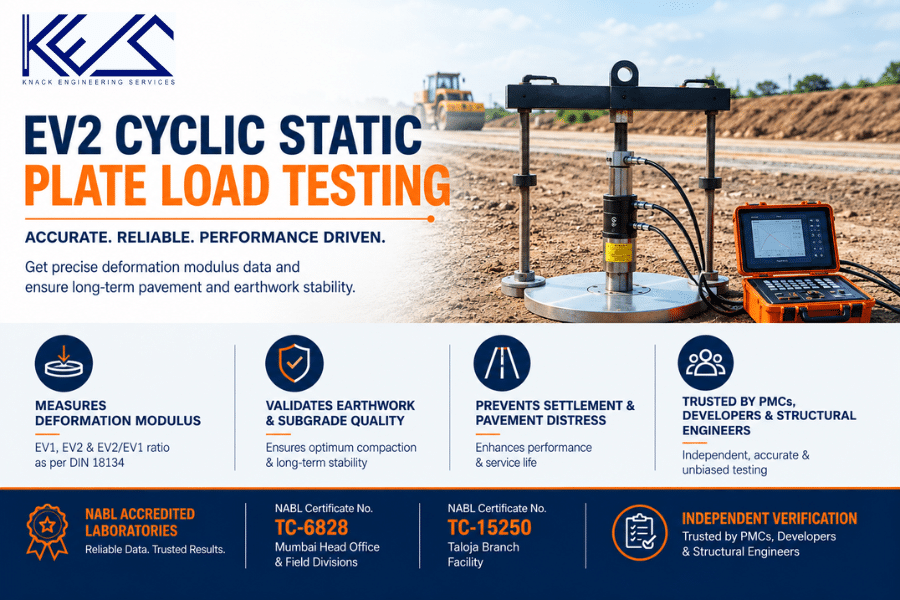
The EV2 static plate load test has become an essential tool for modern infrastructure projects where long-term stability and performance cannot be left to assumptions. By evaluating soil stiffness, deformation behaviour, and compaction quality through deformation modulus DIN 18134, project teams gain confidence in the structural integrity of their earthworks.
Through advanced road subgrade testing Mumbai services and independent earthwork compaction validation, KNACK ENGINEERING SERVICES PRIVATE LIMITED helps developers, PMCs, and structural engineers minimise settlement risks and build infrastructure designed to perform reliably for decades.
Image Reference: Magnific
Disclaimer: All trademarks, logos, and brand names are the property of their respective owners. All company, product, and service names used on this website are for identification purposes only. Use of these names, trademarks, and brands does not imply endorsement.